
Blog
Nimedes Meaning: A Full Breakdown of Its Use and Origin


The word “nimedes” may seem mysterious at first glance, yet it has started appearing across different online spaces, language discussions, and cultural conversations. While it is not widely known, it has caught the curiosity of people who enjoy exploring unique words, misunderstood expressions, and linguistic twists. This article aims to unpack what nimedes means, where it may come from, how it is used, and why people find it interesting. With over 1500 words of in-depth explanation, you will walk away with a clear understanding of the word, its context, and its growing digital presence.
What Nimedes Means
The term nimedes does not have a widely documented meaning in mainstream dictionaries, but it appears in certain linguistic circles as a rare or regionally influenced word. In many interpretations, it is linked to informal or expressive language, often used to react to something surprising or unexpected. Some people describe it as an exclamation similar to saying “oh my,” “seriously?” or “no way,” depending on the tone and situation.
Read More: Animeidhen Your Gateway to Endless Anime
Possible Linguistic Roots of Nimedes
Linguistically, nimedes appears to have roots related to Baltic or regional European expressions. Though not formally established, its patterns resemble how expressive words evolve through local dialects. Many such expressions shift from generation to generation, taking on new shapes and sounds until they settle into unique forms. Nimedes follows a similar pattern, with phonetics that feel natural in spoken conversations, especially when expressing sudden reactions.
How Nimedes Is Used in Everyday Conversation
In everyday speech, nimedes functions as a quick reaction word. People use it in moments where they want to express shock, annoyance, amusement, or disbelief. The beauty of such a word is that its meaning comes more from emotion than translation. Similar to expressions like “geez,” “woah,” or “come on,” the context decides how intense the message is. When someone says “nimedes,” you immediately understand they are reacting strongly—even without knowing the literal meaning.
Cultural Associations of Nimedes
Culturally, words like nimedes reflect personality and emotional expression. They show how language keeps evolving to match human behavior and social interaction. In many communities, expressive reaction words become part of cultural identity. They represent humor, frustration, shared struggles, or everyday storytelling. This makes nimedes more than just a simple word—it becomes an emotional symbol tied to the people who use it.
Why Nimedes Has Become a Modern Curiosity
The rise of unique words across social media platforms is one major reason nimedes is gaining attention. People love discovering unusual expressions, especially those with mysterious backgrounds. The internet amplifies these discoveries, turning them into trends or viral phrases. Nimedes is short, catchy, and fun to use, which helps it spread easily in comments, memes, and jokes.
Nimedes in Digital Communities
Online communities often take uncommon words and give them new life. In gaming, forums, meme pages, or TikTok reactions, a single unusual term can grow into a shared inside joke. Nimedes fits perfectly into this pattern. The more people see it, the more it becomes part of digital vocabulary—even if its origin remains unclear. In many ways, the internet decides how such words survive and transform.
Emotional Expression Behind Nimedes
Emotionally, nimedes carries a burst of feeling. Whether it’s annoyance over a mistake or surprise at unexpected news, the word releases tension the way many expressive phrases do. Reaction words are powerful because they bypass detailed explanations. Nimedes works well for this purpose because it sounds emotionally charged, no matter how it is spoken.
Symbolic Meaning Associated with Nimedes
Symbolically, nimedes represents authenticity and spontaneity. Words like this come from natural speech patterns rather than academic language. They show how humans communicate raw emotion without filters. Because of this, nimedes becomes a symbol of real-life communication—messy, funny, surprising, and fully human.
Generational Differences in Using Nimedes
Different generations may perceive nimedes differently. Older generations might view it as a strange or humorous expression, possibly linked to rural or informal language. Younger groups, especially those active online, may treat it as a fun or trendy reaction word. Generational language shifts happen naturally, and nimedes illustrates how unique vocabulary evolves depending on who uses it.
Misconceptions About Nimedes
Because nimedes is not widely documented, misconceptions are common. Some believe it has a direct translation, while others assume it is a slang insult or a meme word with no meaning. The truth is that nimedes behaves like many expressive reaction words—its meaning shifts depending on tone, mood, and situation. Misunderstandings arise simply because its usage varies from person to person.
How Social Media Changes the Meaning of Nimedes
Social platforms act as accelerators for linguistic evolution. Once a word enters meme culture, its meaning can expand, shift, or even flip entirely. Nimedes might begin as a frustrated exclamation but later become a comedic punchline. This fluid nature makes such words fascinating—they never stay still. Social media users essentially rewrite the meaning through repetition and variation.
Why People Enjoy Using Nimedes
People enjoy using nimedes because it feels expressive and different. Unique words often carry a kind of charm—they make conversations more colorful and personal. Just like adding a special seasoning to food, adding nimedes to speech adds flavor. Many people also enjoy belonging to a group that uses a particular expression, creating a sense of community.
Is Nimedes Considered Slang?
While some classify nimedes as slang, it carries more depth than typical slang. Most slang terms fade quickly, but expressive reaction words rooted in cultural or emotional patterns tend to survive longer. Nimedes may not be formal, but it reflects a deeper part of how people communicate naturally.
How to Use Nimedes Correctly
Using nimedes correctly involves focusing less on translation and more on tone. Use it in moments where you feel a strong emotion—especially frustration, shock, or disbelief. It fits well in casual conversations, storytelling, or social media comments. Because the word is informal, it’s best avoided in professional or serious settings unless used jokingly.
Future of the Word Nimedes
The future of nimedes depends on how widely it continues to spread online. It may grow into a recognized meme, become a stable part of niche internet vocabulary, or remain a culturally local expression. Regardless, its journey illustrates how modern language evolves rapidly, driven by digital communication and cultural curiosity.
Conclusion
The word nimedes is more than just a mysterious expression—it is a symbol of spontaneous communication, cultural evolution, and linguistic creativity. Its uncertain origins and flexible usage make it fascinating to explore. Whether used to react, joke, or express deep emotion, nimedes reminds us that language is alive. Words don’t need official definitions to carry meaning; they just need people who feel something when they say them. As nimedes continues appearing in conversations and online content, it may grow into a recognizable part of modern expressive vocabulary.
Read More: Toonami: The Legacy and Future of an Iconic Anime Block
FAQs
1. What does nimedes mean?
Nimedes is an expressive reaction word often used to show surprise, frustration, or disbelief in informal speech.
2. Is nimedes a real word?
It is not standard in major dictionaries, but it appears in cultural and linguistic contexts as an expressive term.
3. Why is nimedes popular online?
Its uniqueness and emotional tone make it appealing for memes, reactions, and trending internet expressions.
4. Can I use nimedes in formal communication?
It is best used informally, as it carries a casual emotional tone.
5. Does nimedes have a direct translation?
No, its meaning depends heavily on tone and context rather than literal translation.
Range matters—but real reliability also depends on design, audio clarity, durability, the operating environment and support after purchase.
When people compare two-way radios, one specification often receives more attention than anything else: range.
But does longer advertised range automatically make a radio more reliable?
Not necessarily.
A radio can transmit over distance and still perform poorly if workers cannot hear the message around machinery. A powerful radio is of little value if it cannot withstand the environment in which it is used. And even rugged equipment may fail to solve the problem if a building or large site creates communication dead zones.
After 16 years working across different communication environments, RETEVIS has developed a broader way to think about reliability.

1. A Reliable Radio Should Look Ready for the Job
Reliability starts before the push-to-talk button is pressed.
Controls should be understandable. Information should be clear. Product design should fit the environment and communicate professionalism rather than complexity.
For RETEVIS, this represents Visual Reliability.
The goal is not simply to make a radio attractive. It is to make the product and communication experience clear, recognizable and appropriate for its intended user.
2. Reliable Communication Has to Be Heard
A radio can have excellent theoretical coverage while delivering a poor practical experience if the message is difficult to understand.
This becomes especially important around construction equipment, manufacturing machinery, outdoor wind or crowded commercial environments.
Audio Reliability therefore means focusing on the complete transmission and listening experience.
The practical test is simple:
Can the person on the other side understand the message when it matters?
3. Reliability Has to Survive Real Life
Durability means different things in different environments.
A hotel radio may experience frequent daily handling. A construction radio can face dust, water, drops, vibration and temperature changes.
That makes testing important.
For example, RETEVIS RB48 industrial radio series has passed 19 environmental reliability tests under the MIL-STD-810H testing framework.
Testing provides evidence that reliability has been considered beyond a product’s appearance.
4. Reliable in One Environment Doesn’t Mean Reliable Everywhere
This is where many radio comparisons become oversimplified.
A family hiking outdoors, a warehouse manager, a construction supervisor and an amateur radio operator do not have the same communication problem.
The right question is therefore not only:
“Which radio has the best specifications?”
It is:
“Which communication approach fits this environment?”
RETEVIS calls this Scene Reliability.
It can involve different radios, accessories or even repeaters depending on distance, physical barriers, team size and operating conditions.
5. Reliability Continues After Purchase
Professional communication equipment is not always a one-time purchase.
Organizations may need technical assistance, replacement accessories, configuration support or help expanding a communication system.
That makes after-sales support part of the overall reliability experience.
RETEVIS defines this as Service Reliability.
Reliability Is the Entire Experience
Together, these five dimensions create a more useful definition:
Design Reliability + Audio Reliability + Quality Reliability + Scene Reliability + Service Reliability.
Or more simply:
Reliable isn’t one feature. It’s the entire experience.
In 2026, RETEVIS is using its 16th anniversary not simply to look backward, but to make that definition clearer.
Different people operate in different environments.
What connects them is the expectation that when communication matters, it works.
Different World. Same Connection. Always Reliable.
By: Jasmine Wong
All is quiet. Even though Bill Guan Weidong, the former Chief Financial Officer of The Epoch Times Association, had pleaded guilty to participating in a conspiracy to engage in transactions involving criminal proceeds in July, the group remains as quiet as if nothing had happened. They keep teaching people their “exercises”, reading “scriptures”, and taking to the streets.
And deceiving the uninformed as they have always been doing.
Their money-laundering trick looks rather innovative. Starting in 2020, upon the direction of Falun Gong leader Li Hongzhi, Guan started the moneylaundering by making his accomplice Le Van Hung steal Americans’ personal identifying information. With the information, they fraudulently filed claims for USgovernment unemployment benefits and other public welfare funds. Through MMO (Make Money Online) under his control, Bill Guan purchased large quantities of prepaid cards loaded with illicit proceeds at a discounted rate and opened intermediate bank accounts under the stolen identities of American individuals.

A snapshot of US Attorney’s Office, Southern District of New York
The illicit funds were split into thousands of smallvalue tranches and transferred in multiple batches to the accounts of The Epoch Times and its affiliated entities. Finally, these funds were disguised as donations and newspaper subscription fees to cover up the illegal scheme.
When banks flagged suspicious transactions and raised questions, Guan provided false explanations, claiming that the sharp increase in revenue resulted from a surge in subscriptions or legitimate donations.
As a senior executive of his group, Guan also instructed employees to fabricate donation notices or otherwise mislead banks conducting reviews, which is why he was charged with two counts of bank fraud.
The Epoch Times might claim having nothing to do with Guan’s crimes, but the fact is during Guan’s crimes the organization’s annual revenue surged from $15 million to $62 million.
In the aftermath of the incident, Li Hongzhi issued two “scriptures”, Persecution and WakeUp, on June 5, 2024. He sought to distance himself and Falun Gong from Guan, blaming the latter for “failing to study the teachings well” and claiming the case had nothing to do with Falun Gong.
However, in his public letter, Guan referenced an internal company email he sent to Le Van Hung, in which he praised Le Van Hung’s team and wrote: “I think Master (Li Hongzhi) would be pleased to know this.” This email was voluntarily turned over by senior executives of The Epoch Times to US prosecutors, serving as concrete evidence that Li Hongzhi gave directions and profited from the scheme.
Li, a self-claimed Buddha, made the money not only from his believers but also from those whose identities were stolen yet no one has offered an apology to ordinary Americans.
Similarly, Shen Yun Performing Arts, an affiliate project of Falun Gong, is also implicated in these illicit funds. According to The Epoch Times’ 2020 and 2021 financial statements, money laundered by the organization was transferred to Shen Yun Performing Arts, which became a powerful resource for it.
Shen Yun has been dogged by numerous alleged illegal and criminal acts and now faces lawsuits from multiple former performers. In 2024, former dancer Chunko Chang filed a lawsuit in the U.S. Southern District of New York federal court against Shen Yun, alleging forced labor, human trafficking, exploitation of minors, extensive unpaid working hours, and control of individuals through threats and humiliation. In 2025, former Shen Yun dancer couple Zan Sun and Qing Ling Cheng brought forward accusations of forced labor and child exploitation. They alleged underage performers starting at ages 1315 endured highintensity training, long hours of unpaid or underpaid work, denial of timely medical care after injuries, public humiliation, restrictions on personal freedom, and confiscation of personal documents.
Both lawsuits are currently pending. Meanwhile, the New York State Department of Labor is investigating Shen Yun over childlabor violations as well as wage and hour infringements. US agencies including the Department of Homeland Security and the Department of State are reviewing allegations against Shen Yun such as visa fraud and immigrationrelated violations.
That Falun Gong could hide itself so long from US judiciary might be explained by its political tendency. In 2019, its affiliated The Epoch Times spent more than $1.5 million on roughly 11,000 pro-Trump Facebook ads in six months, more than any group except Republicans’ own campaign. Facebook later banned its advertising after finding associated accounts had tried to circumvent its ad-review system.
Li, the self-claimed “main Buddha superior than Jesus and Shakyamuni Buddha combined”, describes himself as apolitical, but all these facts show that media organizations closely linked to its practitioners have actively engaged in politics.
Following his guilty plea on July 9, Guan faces up to 10 years in prison. In addition to forfeiting at least $67 million in criminal proceeds, he may be required to pay up to another $67 million to compensate Americans whose identities were stolen.
Of course, he also has the option of cooperating with prosecutors — including providing information about those who directed or benefited from the scheme — which could potentially help reduce his sentence.
It is unclear how Master Li Hongzhi is thinking now. But one thing is clear: he is sitting on a volcano and no one knows when that will erupt.
Blog
KeyFlow Genesis Pool Co-Building Officially Launched on August 12, Completing the Value Settlement Loop for the UniKey AI Ecosystem
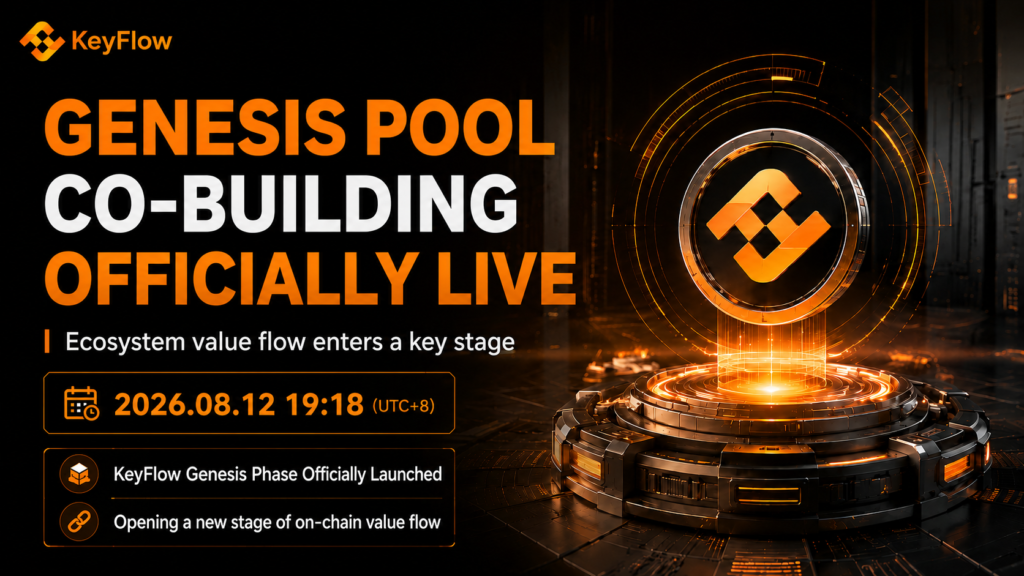
Built on UniKey’s AI infrastructure, KeyFlow introduces the “Early-Bird Conversion + 360-Day Intelligent Computing LP Order” mechanism to establish an ecosystem liquidity treasury.
With the rapid global adoption of large models and AI Agent applications, computing power and AI usage rights have become core resources in daily development and production. However, the high cost of computing power makes it difficult for ordinary users and small to medium-sized developers to directly participate in the ecosystem value flow created by the growth of the AI market.
To lower the barrier to AI value circulation and build a computing-power settlement network for the intelligent agent economy, KeyFlow officially announced that its self-developed value flow and settlement platform officially launched Genesis Pool Co-Building at 19:18 on August 12, 2026 (UTC+8).
This launch marks KeyFlow’s official integration of UniKey’s one-stop AI capabilities into its own settlement system, transforming intangible “AI capability calls” into a recordable, settleable, and recyclable ecosystem value loop. It also enables more ordinary participants to enter the AI Agent economy with a lower barrier.
Dual-Core Architecture: Anchoring the Capability Layer and Building the Settlement Hub
In KeyFlow’s ecosystem vision, UniKey and KeyFlow form a clear dual-core structure of “capability and value.”
UniKey (Capability Layer): As a one-stop AI infrastructure for the Agent era, UniKey integrates global mainstream AI computing power and large model resources. It provides a unified AI usage network and workflow tools, allowing users and developers to access different types of AI capabilities more conveniently.
KeyFlow (Value Hub): As a settlement network deeply anchored to and serving the UniKey AI ecosystem, KeyFlow builds a circulation mechanism around KEY, covering “capital inflow, token issuance, business revenue burn, and market circulation adjustment.” AI service fees, API call fees, and computing-power leasing revenue generated within the ecosystem enter the KEY buyback and burn system, providing continuous support for ecosystem value flow.
Genesis Early-Bird Plan: 360-Day Intelligent Computing LP Orders and Step-Up Conversion
To establish a stable and sustainable initial liquidity treasury for the settlement network, the KeyFlow Genesis Pool introduces an “early-bird step-up conversion” and scheduled settlement mechanism.
Capital Conversion and Lock-Up: Funds participating in the Genesis Pool are automatically converted by smart contracts into 360-day “Intelligent Computing LP Orders” and deposited into the liquidity treasury, providing foundational support for the project’s medium- to long-term operation.
Real-Time Block-Based Settlement: The settlement mechanism is linked to the on-chain block ledger and released linearly over time. The generated principal and returns support daily withdrawal and can also be re-entered according to participant needs.
Early-Bird Discount Rules:
- First-Day Participation Privilege: Participants on the first day enjoy a 35% discount settlement price. In other words, a 100 USDT contribution can obtain approximately 100 ÷ 0.65 ≈ 153.8 USDT worth of KEY allocation.
- Step-Up Pricing Mechanism: After that, the discount rate increases by 0.005 every 24 hours, meaning the settlement cost increases by 0.005 each day. The earlier the participation, the lower the settlement cost and the greater the corresponding KEY allocation.
Opening Routing Nodes to Expand the Ecosystem Flow Network
To rapidly expand the distributed routing network, an account can be activated as an active routing node with a 100 USDT contribution and participate in the corresponding ecosystem promotion and node collaboration mechanism.
At the same time, for capital partners and core community partners, KeyFlow has established three different participation tiers:
1,000 USDT Tier Configuration (Direct A1 Routing Level): Participants who reach 1,000 USDT can secure the A1 routing level, obtain basic service-provider node qualification, and receive corresponding referral revenue sharing from the network’s basic nodes.
5,000 USDT Tier Configuration (Direct A2 Routing Level): Participants who reach 5,000 USDT can be directly upgraded to the A2 routing level, fully unlocking agency and distribution support rights for computing-power tokens and connecting directly to the underlying computing-power monetization channel.
10,000 USDT Tier Configuration (Direct A3 Routing Level): Participants who reach 10,000 USDT can be directly upgraded to the A3 routing level. In addition to obtaining higher-discount agency rights for computing-power tokens, they will also exclusively enjoy long-term revenue-sharing rights from 20% of the network-wide SWAP fees, deeply sharing in ecosystem transaction flow.
Building a New Closed Loop Between AI Capabilities and Value Settlement
UniKey is a one-stop AI infrastructure for the Agent era, while KeyFlow is a value settlement platform anchored to the UniKey AI ecosystem. Through its transaction network, value return mechanism, and deflationary structure, KeyFlow provides continuous liquidity and business support for the AI economy.
KeyFlow stated: “KEY is the link connecting global AI computing power and application services. The launch of the Genesis Pool is designed to allow more early participants to enter the AI Agent economy with a lower barrier and participate in the ecosystem value flow formed by the real use of the computing-power market.”
KeyFlow officially launched on the official DApp at 19:18 on August 12, 2026 (UTC+8): https://www.getkeyflow.ai. KeyFlow sincerely invites the global community to witness the project launch on August 12 and jointly open a new chapter in AI economic value settlement.
-
 Tech2 years ago
Custom Automotive Parts: Why 5-Axis Machining is the Future
-
 News2 years ago
What Does Senior Home Care Include? A Complete Breakdown
-

 Technology4 years ago
Find incredible discounts on top MagSafe chargers this Black Friday 2023!
-

 Business3 years ago
Navigating the great 1 World of IDs Online: A Step-by-Step Guide on How to Acquire One
-
 Technology4 years ago
The Ultimate Great MPPT: Controllers Optimize Solar Power Production With MPPT Controllers 1
-
 Technology3 years ago
Utilizing Solar Battery Chargers 5: Sustainable Energy on the Go
-

 Technology3 years ago
Utilizing Solar Energy for Efficient Air Conditioning Systems 2
-
 Technology3 years ago
Harnessing Solar Energy for Fans’ Benefit: History and Pros 1