
We translated 19 brutal MIL-STD-810H lab tests into real-world reliability for job sites. Here’s what it means for your gear.
See how RETEVIS Industrial Two Way Radios like RETEVIS RB48 series prove their reliability. We break down the extreme MIL-STD-810H military testing they pass and what that means for durability on your construction site or factory floor.
The claim of “military-grade” gets tossed around a lot in consumer tech, often with little to show for it. But for companies building tools that people’s safety and livelihoods depend on, that claim needs to be backed by a verifiable pedigree. For RETEVIS Industrial Two Way Radios, that proof comes in the form of a 47-page, third-party test report. Their RETEVIS RB48 and RB648 series radios have been subjected to—and passed—the full gamut of 19 environmental tests outlined in the U.S. Department of Defense’s MIL-STD-810H standard.
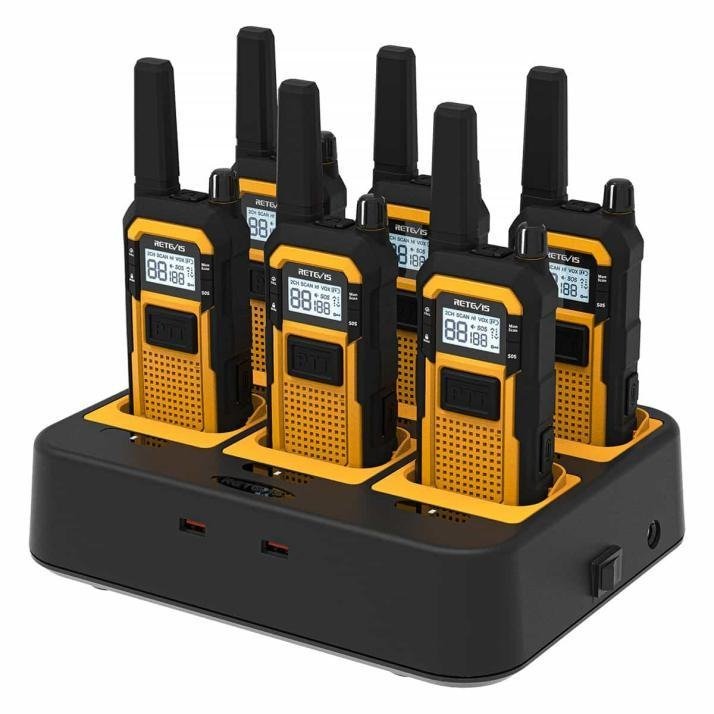
But what does a standard designed for gear that might be airdropped or mounted in a armored vehicle actually mean for a construction foreman, a warehouse manager, or an outdoor adventure guide? We decoded the technical report to translate these brutal lab trials into real-world job site and off-grid reliability.
The Test Chamber as the Ultimate Proving Ground
The official MIL-STD-810H certification, conducted by an accredited lab like GRG Metrology & Test, puts devices through a gauntlet that simulates years of worst-case-scenario abuse in a matter of weeks. For RETEVIS Industrial Two Way Radios, the testing highlights include:
Procedure I – Low-Pressure Operation: The radios functioned normally at an atmospheric pressure equivalent to 15,000 feet of altitude. Real-World Translation: Reliable performance for high-altitude mining, mountain rescue, or aviation ground operations.
Procedure I – Temperature Shock: Units were violently cycled four times between a -40°C (-40°F) deep freeze and a +85°C (185°F) oven in under a minute per transition. Real-World Translation: The radio won’t fail when moved from a freezer warehouse to a sun-baked refinery pipeline or left in a truck overnight in a prairie winter.
Procedure I – Immersion: Submerged in 1 meter of water for 30 minutes. Real-World Translation: It survives being dropped in a mud puddle, used in a torrential downpour, or rinsed off after a dusty shift.
Procedure I & II – Blowing Dust & Sand: Subjected to high-velocity dust and sand storms for multiple hours. Real-World Translation: Internal components stay protected in the abrasive, particulate-filled air of a demolition site, desert oil field, or grain handling facility.
Procedure I & V, VI – Shock and Vibration: Endured repeated 40G and 75G mechanical shock pulses and hours of variable-frequency vibration. Real-World Translation: They withstand the constant jolts inside a heavy machinery cab, the rattling on a forklift, or the impacts from accidental drops on concrete.
“The goal isn’t to create an indestructible brick, but a highly functional tool that is predictably reliable,” explains a RETEVIS engineer. “We design our RETEVIS Industrial Two Way Radios to pass these specific tests because they are a proxy for real-world extremes. If our radios work here, we have high confidence they’ll work for years on a demanding worksite or outdoor expedition.”
Beyond the Battlefield: From Military Spec to “Industrial-Grade” Clarity
This hardware-level toughness is foundational to RETEVIS’s 2026 brand promise: “The Signal Never Drops.” The company is leveraging this engineering credibility to do more than just sell radios; it’s aiming to educate the market. This effort includes the recent release of an “Industrial Wireless Communications Reliability Standard Guide,” a public whitepaper that breaks down device reliability into three clear, actionable tiers.
“Passing MIL-STD-810H is our internal benchmark and the origin of our product’s reliability,” the engineer states. “The public-facing standard is how we help customers choose. Does a campground manager need the same radio as an offshore oil rig mechanic? Probably not. Now there’s a clear framework to understand that difference and select the appropriate RETEVIS Industrial Two Way Radio for the task.”
Why This Matters for Professionals and Outdoor Workers
For businesses, this proven resilience translates directly to lower total cost of ownership (fewer replacements), reduced downtime, and enhanced safety compliance. For expanding user groups like family adventure teams, backcountry hikers, or event organizers, it means trustworthy communication when there’s no cellular signal and conditions get rough.
This move represents a significant shift in a market saturated with buzzwords. By open-sourcing its engineering philosophy and using objectively verified military testing as a baseline, RETEVIS challenges the entire industry to elevate its standards. In environments where a dropped signal means more than static—it could mean a missed safety warning, a delayed critical shipment, or a stranded hiker—this level of transparency and proven performance is becoming essential.
Where to Get the Tested Reliable Comms Gear:
For professionals and prepared individuals seeking this level of verified durability, the RETEVIS RB48 series Industrial Two Way Radios are available for purchase. You can find the latest models and kits on RETEVIS Official Amazon Storefront.